

Interplay of mental state, personality, and popularity among peers in shaping belongingness of first-year students: A cross-sectional study
Abstract
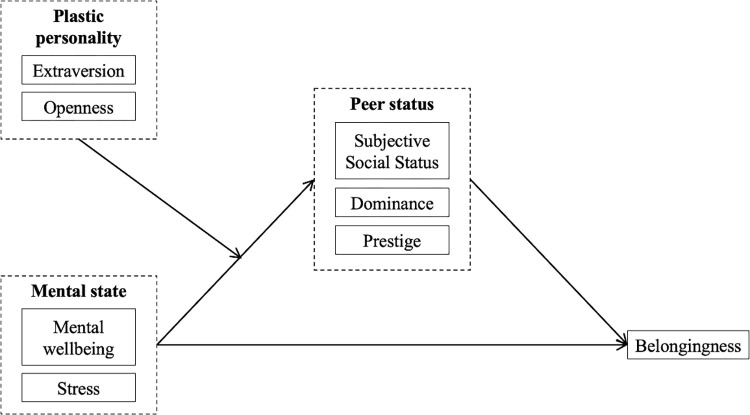
Belonging to a university shapes wellbeing and academic outcomes for first-year students, yet this belongingness is harder to achieve for those from lower socio-economic backgrounds. This study delved into the flexible construct of status—the individual's perceived position within the university's social hierarchy and the strategy they adopt to achieve that position—and its impact on their belongingness. The objective was to identify key psychological contributors that could impact first-year Psychology students expected social status and thereby their belongingness. A cross-sectional study tested first year Psychology students entering university in 2021 and 2022. The first-year students completed a battery of questionnaires to ascertain their status, belongingness to the university, mental state, and personalities. Structural equation modelling (SEM) was employed to evaluate a social ecological model focusing on belongingness. This analysis investigated the mediating role of peer status (popularity among peers) in the relationship between mental state and belongingness, and the moderating influence of personality traits on the connections between mental state and peer status. Both the mediation and moderation effects were statistically significant after adjusting for gender and ethnicity. The findings offer insights into how university administrations can effectively support students, particularly those from lower socio-economic backgrounds, in enhancing their social status among peers and fostering a stronger belongingness, thereby promoting their overall mental wellbeing and success in their academic pursuits.
Key Findings
Mental state and belongingness
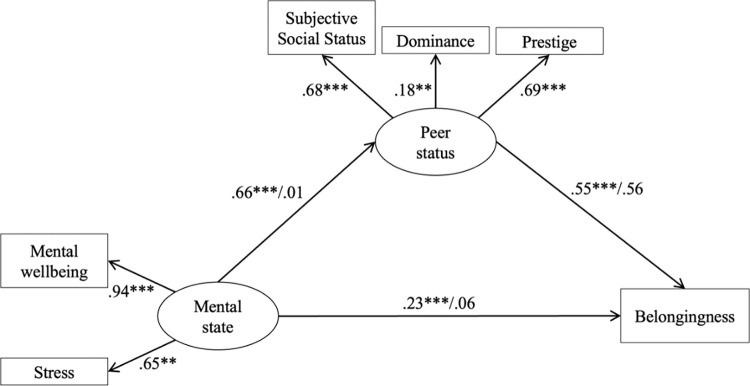
Mental state explained 21% of the variability in university belongingness among first-year Psychology students, supporting the importance of personal psychological factors in how students adapt to higher education.
Peer status as a mediator
Higher mental state predicted higher peer status (β = 0.66, p < .001), and higher peer status was associated with greater belongingness (β = 0.55, p < .001). Peer status fully mediated the relationship between mental state and belongingness (indirect effect β = 0.23, p < .001).
Personality as a moderator
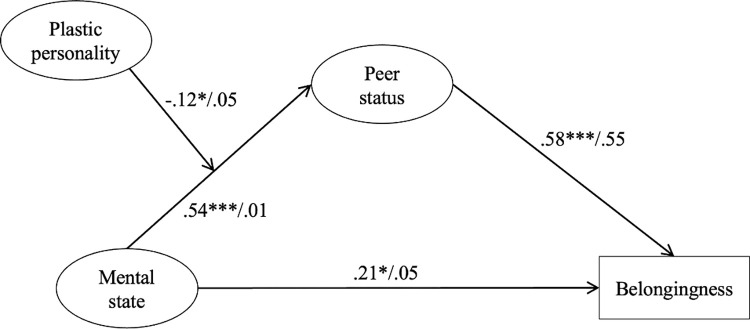
Plasticity traits (extraversion and openness) significantly moderated the link between mental state and peer status. Plasticity independently predicted higher peer status, while higher plasticity reduced the positive impact of mental state on peer status—highlighting how personality shapes social positioning at university.
Figures
Published figures from the open-access version on PubMed Central (CC BY 4.0).
Publication Details
Links
Suggested Citation
Zhang, A., Kazazi, F., Tang, K., & Howell, P. (2024). Interplay of mental state, personality, and popularity among peers in shaping belongingness of first-year students: A cross-sectional study. PLOS Mental Health, 1(2), e0000019. https://doi.org/10.1371/journal.pmen.0000019